


search
date/time

Fri, 4:00PM
overcast clouds
14.8°C
SW 7mph
overcast clouds
14.8°C
SW 7mph
 | Sunrise | 4:19AM |
| Sunset | 7:55PM |  |

Andrew Liddle
Guest Writer
P.ublished 21st March 2026
frontpage
The Thucydides Trap in Motion
Andrew Liddle considers the impact of the war in Iran
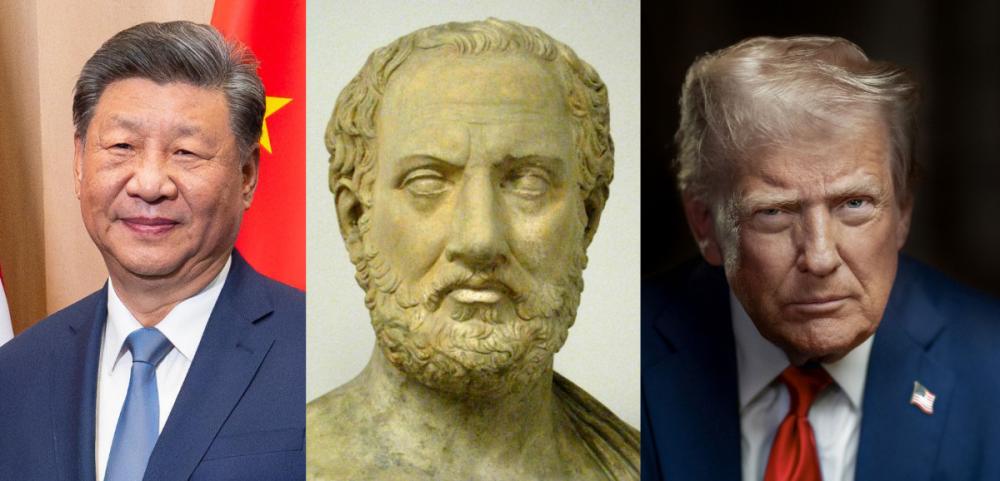
Xi Jinping, Thucydides and Trump
For a time in the early part of this century it seemed to crop up trendily whenever Chinese expansionism was discussed. I saw the phrase frequently in the editorials of serious newspapers and political magazines, tossed in casually as some sort of clever historical metaphor - rather than the serious warning about the future it should have been.
It offered a lesson, drawn from antiquity, that when a rising power threatens to displace an established one, war often follows. The name comes from the ancient Greek historian Thucydides, who observed that the Peloponnesian War between Athens and Sparta was driven less by immediate causes than by a deeper structural fear that the former’s rise provoked in the latter, even though the two powers had not initially sought war.
Though the phrase sounds like the spicy title of a Robert Ludlum spy novel - which is probably why I remember it - it was coined by Graham Allison, a Harvard professor and former U.S. national security adviser. He borrowed the concept to explain why rising powers and established ones - like respectively China and the United States - can drift toward confrontation even when neither side actively desires war. The trap springs because the danger is deeply structural, not merely the product of modern politics or particular crises but of systems, world views, cultures in collision.
What has always unsettled me about this idea is its fatalistic implication that intention matters less than in-built structures, programming, systems. Even cautious and rational leaders may find themselves pulled toward rivalry simply because the balance of power is shifting beneath them or around them.
I’ve been thinking about this lately while watching events unfold in Iran at a time when Britain seems to be cosying up to China and drifting away from the USA. With Iran in flames and being bombed relentlessly, the prolonged closure of the Strait of Hormuz threatens one of the great arteries of the global energy system. A large share of the world’s seaborne oil passes through this narrow channel, so any sustained conflict in the region has immediate global consequences and energy markets have reacted sharply.
Prolonged instability could actually generate windfall revenues for Russia, which possesses vast oil reserves of its own, while creating serious economic challenges for China, whose industrial economy depends heavily on energy imports from the Gulf. What strikes me most is how quickly a regional conflict begins to put the entire international system under stress.
So far neither China nor Russia has moved decisively to defend Iran despite their political alignment with Tehran. Instead, they have offered diplomatic support and rhetorical backing while carefully avoiding direct confrontation with the United States.
Their caution reveals something important about the emerging geopolitical landscape. The authoritarian powers challenging the Western order are not yet bound together by formal military alliances. What unites them is not treaty obligations but a shared strategic objective of weakening the American-led international system and replacing it with something more favourable to their own political survival and geopolitical ambitions.
The Iran war may be giving us a glimpse of a new world order taking shape, in which rival blocs test each other’s limits indirectly - Cold War-style - careful not to trigger a catastrophic clash. In 1989, the fall of the Berlin Wall appeared to signal the end of ideological rivalry between the two great powers and many concluded that liberal democracy and market capitalism had triumphed. The task ahead, it seemed, was simply to extend the institutions of globalisation to the rest of the world and strategic rivalry would fade and economic integration would do the rest. However, the assumption that economic prosperity would gradually soften authoritarian rule now feels absurdly naive.
In 2001 when China joined the World Trade Organisation - after 15 years of intense negotiations - Western leaders smugly believed they had discovered the magic formula for peaceful transformation. Here was the New Millennium. Integrate China into the global economy, allow trade and investment to enrich its society, and the country would gradually converge with liberal political norms and be happy to import Western values, culture and prosperity. Job done!
Not so! What actually happened was the opposite, because China used globalisation to strengthen its totalitarianism rather than weaken it. Economic growth actually provided the resources for the Communist Party to build one of the most sophisticated systems of political control in modern history with digital surveillance, facial recognition, and data-driven monitoring becoming embedded in the fabric of life.
When Xi Jinping came to power in 2013, the process accelerated dramatically. Political centralisation increased, ideological discipline hardened, and the party inserted itself more deeply into every domain of Chinese society. China became richer, more technologically advanced, more authoritarian and more predatory and expansionist in outlook.
For years, the prevailing assumption has been that Beijing would not attempt to match America’s military power despite its booming economy. I remember hearing the argument repeatedly being put that Marxist-Leninist regimes traditionally fear building overly powerful armed forces that might overthrow them, the ruling party.
In retrospect, that confidence was vastly misplaced, because in the past two decades China has embarked on one of the most extensive military modernisations in modern history. The strategic objective appears to be to build armed forces capable of challenging American and European dominance.
The one area where China still lags behind is nuclear weapons. For decades Beijing maintained a relatively small arsenal designed primarily for deterrence. Ominously, the Red Dragon has begun expanding its nuclear capabilities and within a decade it may possess a nuclear force approaching parity with the United States.
During the Cold War, western strategic planning assumed the possibility of facing one nuclear competitor, specifically Russia. The prospect of confronting two simultaneously was considered too expensive to prepare for seriously. It is no longer unlikely and though America may be able to take out Iran’s nuclear weapons it could not attempt the same with China’s.
Policymakers all along have seriously misjudged China’s ideological appeal abroad, assuming that their political model would never prove attractive to other countries. Governments might trade with Beijing, but they would not want to get too close or friendly. (Keir Starmer for one appears to be very chummy with everything Chinese.)
Yet the global environment in which that judgement was made has changed, and frustration with the Western-led order has grown across much of the developing world. Military interventions, sanctions attempting regime change and the inequality of economic relationships have conspired to weaken the perceived legitimacy of the super-power world order constructed after the Second World War.
China has exploited this disillusionment with considerable skill, while expanding its spheres of influence. Their strategists spent years developing an alternative vision of international cooperation. The ‘Belt and Road project’, launched in 2013, emphasised long-term infrastructural development, involving huge investments in projects like roads, railways, ports, and energy production across Asia, Europe, Africa, and beyond, with more than 140 countries participating. Increasingly, governments view China’s proposals as an alternative to Western dominance.
Another development once considered unlikely is the gradual alignment of authoritarian states that share deep hostility toward the existing international system. China, Russia, Iran, and North Korea differ in ideology and economic strength, yet they increasingly coordinate their diplomatic and military behaviour.
So where does the Iran war fit into this emerging pattern? Iran is not a great power, but its confrontation with the West distracts attention, disrupts energy markets, and exposes divisions within Western alliances. For Russia the conflict pushes oil prices upward, cushioning the impact of sanctions. For China it highlights the vulnerability of the global energy routes on which its economy depends.
As for Britain, under a weak and indecisive prime minister, it is patently clear we no longer possess the economic scale or military weight to strategically shape the emerging world order. Though we remain a significant power, with nuclear weapons, global financial influence, and a permanent seat on the United Nations’ Security Council, we have in recent decades been infiltrated by China and increasingly dependent on it.
China has spent years positioning itself in British industries likely to define the future of industrial production, for example electric vehicles, renewable energy technology, shipping, and advanced manufacturing. Control of these networks creates immense leverage, as we are seeing.
In many ways, the new Cold War differs fundamentally from the old one. Whilst the Soviet Union largely isolated itself from the global capitalist economy, China has done the opposite. It has embedded itself deeply within global trade networks, making disentanglement extraordinarily difficult.
Only in one significant area has China failed to make giant strides, that of the global financial system which remains overwhelmingly dominated by the United States. The dollar functions as the world’s primary reserve currency and the central medium of international payments. China’s currency, the renminbi, accounts for only about one fifth of global transactions.
This imbalance creates a strategic risk for Beijing because the United States can weaponise financial infrastructure through tariffs, sanctions, asset freezing, and restrictions on access to dollar-based payment systems. Chinese policymakers are therefore attempting to expand the international role of the renminbi and develop alternative payment networks, making them an attractive proposition to a fading financial force like, say, Britain, and desperate left-leaning governments!
The Iran war may well matter historically much less for its immediate outcome in the Middle East than for what it reveals elsewhere about the direction of global politics, the militarisation of the great powers, the competition for technological dominance, the struggle over financial systems, and the emergence of authoritarian coalitions.
Increasingly, I suspect historians may judge the time we are living through as the moment when a new Cold War began to heat up and it became apparent that economic interdependence has not eliminated east-west rivalry but merely given it new and more complex forms and sinister implications.
Russia is no longer the sole enemy. Without a shadow of a doubt China is the new rising power. We may be witnessing the Thucydides Trap in motion.