


search
date/time

Fri, 7:00PM
light rain
15.1°C
E 1mph
light rain
15.1°C
E 1mph
 | Sunrise | 4:19AM |
| Sunset | 7:55PM |  |

Andrew Liddle
Guest Writer
P.ublished 7th March 2026
arts
Bill Broady And The Fiction Of Labour’s Origins

Bill Broady
The birth of the Labour movement, for all its world-changing consequences, has rarely been explored in contemporary British fiction. It looms large in social history, memoir and political biography but seldom receives sustained imaginative treatment. That absence makes Bill Broady’s great novel, The Night-Soil Men, feel both timely and unusually distinctive, as the modern incarnation of the Labour Party, under Sir Keir Starmer, is seemingly moving farther and farther away from its roots.
Broady is not a writer who trades in grand claims for himself. A former Bradford Grammar School scholarship boy, he has lived and worked in the city for much of his adult life, and his fiction is rooted in its streets, institutions and social habits. Bradford is not simply a setting in his work; it is the moral and imaginative ground from which it grows.
In this sense, Broady belongs to a long but unfashionable tradition of English writing: the civic novel. One thinks immediately of J.B. Priestley, whose fiction and essays treated Bradford as a serious place - a city where ideas were tested against lived experience. There are also echoes of Elizabeth Gaskell, whose industrial novels refused to separate politics from personal feeling, and of George Eliot, whose great achievement was to show how historical forces press upon individual conscience.
Like those writers, Broady understands that political change does not arrive fully formed. It emerges from conversations, compromises, friendships and fractures. The Night-Soil Men opens not with rhetoric or spectacle, but with a deliberately unremarkable scene: a January morning in 1893, snow falling, the clock on Bradford Town Hall striking nine, two policemen lighting their clay pipes.
“The world was about to be turned upside down,” Broady told me, echoing his own prose, when I interviewed him for the Bradford Telegraph & Argus, “even though no one knew it at the time.”
That morning sees the inaugural meeting of the Independent Labour Party, an event that would reshape British politics. Two men walk through the streets carrying pencils for the delegates - a small, almost incidental detail, but one that signals Broady’s method. History, in this novel, advances through the accumulation of the everyday, much as it does in Eliot’s Middlemarch, where great change is rooted in apparently minor acts.
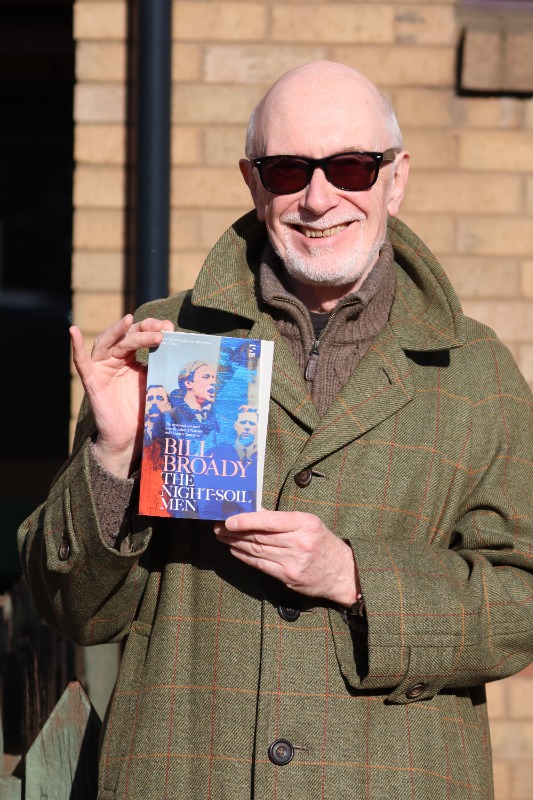
Bill Broady
For older generations in the city, Jowett lingered in living memory. “Misty-eyed old men were still talking about him when I was young,” Broady recalls. “They spoke of him as incorruptible.”
The novel traces the ILP’s rise through the interwar years, capturing both the optimism of a movement that believed politics could be ethical, and the heartbreak that followed when ideals collided with power. Alongside Jowett, Broady brings in figures such as Philip Snowden, born in Cowling and Britain’s first Labour chancellor, and Victor Grayson, the charismatic and ultimately tragic winner of the 1907 Colne Valley by-election.
What distinguishes The Night-Soil Men from more schematic political fiction is its refusal to simplify. Broady is alert to contradiction and moral ambiguity - to the way idealism can shade into self-deception, and to the emotional toll exacted by loyalty to a cause. In this, the novel quietly echoes Marx’s observation that “men make their own history, but they do not make it as they please”: political movements are shaped as much by circumstance, character and compromise as by conviction. It is a sensibility closer to Gaskell’s North and South than to any modern political thriller, concerned less with victory than with the human cost of belief.
The novel’s closing scene, decades later, at the scattering of Snowden’s ashes on Cowling Moor, is devastating. It marks not a triumph but a reckoning, a recognition of how far the movement has travelled and what has been lost along the way.
Broady’s prose is grounded, often dryly comic, and notably resistant to rhetorical flourish. There is something almost Priestleyesque in his attention to pubs, meeting rooms and ordinary social spaces, places where, as JBP understood, private hopes and public life intersect.
The novel took five years to write, following extensive research in the Bradford and West Riding archives and the Museum of Labour History. “It was probably floating around in my head for 30 years,” Broady says. “The way the details kept collecting, like iron filings on a magnet, made it feel as if the book wanted to be written.”
That sense of inevitability - of a story insisting on being told - gives the novel its force. At a moment when political fiction often retreats into allegory or dystopia, The Night-Soil Men insists on the drama of real history: of meetings held in back rooms, of friendships tested by principle, of movements built painstakingly from below.
By returning to the origins of Labour through fiction, Broady is not attempting to monumentalise the past. Instead, he restores its texture - its contingency, its moral seriousness, its human fallibility. In doing so, he reopens a tradition of English writing that once treated politics as inseparable from everyday life.
It is a reminder that the labour movement did not begin as an abstraction, but as a lived, local struggle – and that some of the most important stories in British political life are still waiting to be properly told - whilst, indeed, we are living through cataclysmic political history in the making. The election of the Green candidate in the recent by-election might suggest that once again the political world may be about to be turned upside down.
Book Review: The Night-Soil Men By Bill Broady