


search
date/time

Fri, 4:00PM
overcast clouds
14.8°C
SW 7mph
overcast clouds
14.8°C
SW 7mph
 | Sunrise | 4:19AM |
| Sunset | 7:55PM |  |

Andrew Liddle
Guest Writer
P.ublished 14th March 2026
frontpage
Eighty Years After The Iron Curtain
Andrew Liddle considers how Churchill’s warning still echoes across Europe
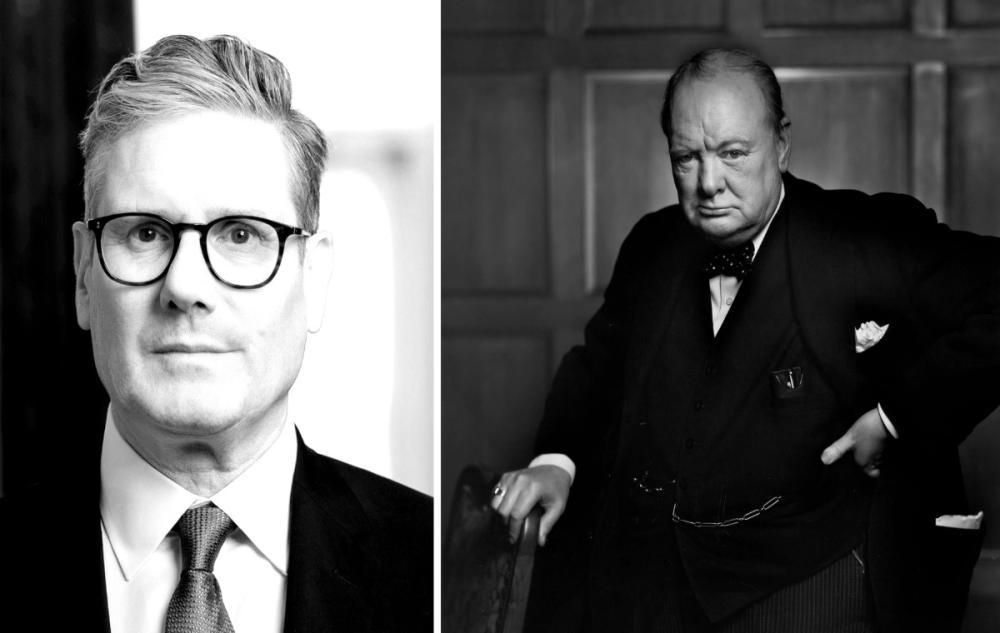
Still, the comparison touches a familiar nerve in British political life. The shadow of Sir Winston Churchill continues to fall across every occupant of Downing Street. In moments of crisis, or even mild uncertainty, prime ministers inevitably find themselves measured against the man who led Britain through its darkest hour to what he himself called its “finest hour”.
Trump’s remark was also oddly well timed. It came almost exactly eighty years after Churchill delivered the speech that introduced the phrase “Iron Curtain” to the world - a moment that revealed his remarkable ability to see beyond the immediate aftermath of war and recognise the emerging shape of global politics.
On 5 March 1946 Churchill travelled to Westminster College in the small American town of Fulton, Missouri. The speech he delivered there is best remembered for a single phrase that has echoed through modern history: “From Stettin in the Baltic to Trieste in the Adriatic,” Churchill declared, “an iron curtain has descended across the Continent.”
Behind that line, Churchill warned, the capitals of central and eastern Europe, Warsaw, Prague, Budapest, Bucharest, Sofia among them, were all increasingly being subjected to Soviet influence and, in some cases, direct control from Moscow. Communist parties in those countries, he argued, had been elevated far beyond their natural democratic strength and were striving to establish totalitarian rule.
Today the speech is often described as one of the opening salvoes of the Cold War. Yet the circumstances in which it was delivered were far less clear-cut than hindsight sometimes suggests.
Churchill was no longer prime minister when he spoke those words. The British electorate had voted him out of office in the general election of July 1945, handing power to Clem Atlee’s great reforming Labour government. The wartime leader now found himself on the opposition benches in the House of Commons.
Even so, he remained one of the most recognisable figures in the world. When he travelled to Missouri to receive an honorary degree, he was introduced to the audience by the President of the United States himself, Harry S. Truman. The president’s presence ensured that Churchill’s words were widely reported and discussed.
Churchill titled his address The Sinews of Peace, a characteristically grand phrase that captured his central argument: peace was not something to be preserved by goodwill alone. It required strength, unity and a realistic understanding of power. Zack Polanski, of the Green Party, might do well to study it.
In retrospect the Fulton speech is frequently treated as the moment when the Cold War began. But in early 1946 the future of Europe was far from settled. The War had ended less than a year earlier. The United Nations had only just been created in the hope of preventing future global conflicts. Only the United States possessed atomic weapons, and millions of soldiers across Europe and the Soviet Union were still being demobilised.
Many people believed that the wartime alliance between the Western democracies and the Soviet Union might survive into peacetime. The devastation of the war was still painfully fresh, and few wished to contemplate the possibility of another global confrontation. Churchill, however, believed that relations were already deteriorating. The Soviet Union under Joseph Stalin had emerged from the war enormously powerful. The Red Army occupied much of eastern and central Europe, and communist regimes were beginning to consolidate their authority in countries that had previously been independent.
Churchill acknowledged that the Soviet Union had legitimate security concerns after suffering immense wartime losses. Yet he feared that Moscow was moving beyond self-defence towards political domination. His image of the Iron Curtain captured that concern with striking clarity.
Behind the curtain, he suggested, information was restricted, opposition suppressed, and national sovereignty increasingly subordinated to the will of the Kremlin. If that process continued unchecked, the balance of power in Europe would be fundamentally altered.
The response to Churchill’s speech was swift and dramatic. In the United States many policymakers welcomed his bluntness. American officials were already beginning to question whether cooperation with the Soviet Union could continue. Within a year President Truman would announce a new strategic approach - the Truman Doctrine - committing the United States to supporting nations threatened by communist expansion. President Trump has recently suggested this is no longer entirely possible or desirable.
Moscow reacted very differently. Stalin denounced Churchill as a warmonger and accused him of advocating an alliance of English-speaking nations reminiscent of racial theories once advanced by the Nazis. The exchange marked a sharp escalation in rhetoric between the former wartime allies.
Yet the British Bulldog himself did not see his speech as a call for permanent confrontation. His argument was more nuanced than later interpretations sometimes suggest. He believed that peaceful coexistence with the Soviet Union remained possible, but only if Western democracies approached the relationship with clear purpose and firm resolve, not passive acceptance.
Central to his thinking was the importance of unity. Churchill believed the wartime partnership between Britain and the United States had forged a unique bond, which he famously described as the “special relationship,” a phrase that has since been repeated by politicians on both sides of the Atlantic with varying degrees of conviction. We must ask ourselves if it still exists, after Starmer’s government initially refused America to use our airbases.
He also stressed the need for greater co-operation among European nations themselves. Europe had been the battleground for two catastrophic wars in little more than a generation. If the continent were to avoid repeating that tragedy, its countries would need to find new ways of working together rather than drift back into the rivalries of the past.
In the decades that followed, many of Churchill’s concerns proved prescient. The Iron Curtain became both a political and physical reality dividing the continent. Communist regimes consolidated power across eastern Europe, while western nations developed their own institutions and alliances in response.
NATO was formed in 1949, binding the United States and much of Western Europe into a collective defence system. At the same time the gradual process of European integration eventually produced what would become the European Union. The Cold War that Churchill seemed to foresee would endure for more than four decades.
For a brief moment, however, it seemed the curtain might have lifted. The reforms introduced by Mikhail Gorbachev - glasnost and perestroika - loosened Soviet rigidity, opening a path to dialogue with the West. The Berlin Wall fell in 1989 to universal rejoicing: the Soviet Union collapsed in 1991. For a while, Europe seemed capable of a more co-operative order. Peace appeared possible.
That optimism has proved fragile. Russia, under Vladimir Putin, has reasserted itself as a geopolitical challenger. The warning signs were visible in 2014 with the annexation of Crimea, and became undeniable in 2022 with the full-scale invasion of Ukraine, in the largest war on European soil since 1945. It shows no signs of ending soon.
In response, Europe has strengthened its eastern frontier with new defensive deployments, stretching from the Arctic to the Black Sea. Once again, a line of influence - a shadow of Churchill’s iron curtain - is being drawn across the continent.
The Cold War is not back in its original form. The twenty-first-century geopolitical landscape is more complex, less neatly divided and the greater danger might well be in the Middle East. Yet the tension between authoritarian power and democratic alliances persists.
Against that backdrop, the pointed jibe that Starmer is “no Churchill” resonates beyond mere Trumpian transatlantic theatre. Churchill’s greatness lay not only in his oratory, nor in his wartime leadership. It lay in his instinct for recognising historical turning points and giving them language before the world fully understood what was happening. Our robotic Prime Minister assuredly has no Churchillian qualities, no political instincts, no discernible strengths.
In 1946 Churchill sensed that the end of one war had not ended global rivalry. It had only ushered in a new and uncertain chapter. Eighty years on, that insight feels uncomfortably relevant.
The institutions he championed, including the United Nations, the Atlantic alliance and the Britain–U.S. partnership, remain central pillars of the international system, yet all show strains that would have troubled him. Peace, Churchill would have reminded us, is never self-sustaining. It demands alliances, vigilance and the courage to confront uncomfortable realities.
Whether any contemporary politician can truly be compared with Churchill is doubtful. But the questions he raised in Fulton eight decades ago, about unity, security, and defending democratic values, remain as urgent today as they were then.
Last week Churchill’s statue was vandalised, shamefully. This week it was announced that Churchill’s image will eventually be removed from Britain’s paper currency, to be replaced by an animal yet to be chosen. If symbolism still matters in public life - and Churchill certainly knew it did - the choice seems obvious. A British bulldog would do nicely.