


search
date/time

Tue, 1:00AM
scattered clouds
19.2°C
ENE 2mph
scattered clouds
19.2°C
ENE 2mph
 | Sunrise | 3:36AM |
| Sunset | 8:49PM |  |

Andrew Palmer
Group Editor
P.ublished 14th March 2026
arts
The Spy WHO Nodded At Me
.jpg)
Ava Glass
Ava Glass laughs when I bring it up. It is, I quickly discover, a terrific laugh — warm, spontaneous, and entirely at odds with the clandestine world she writes about with such authority. She makes me think, in the best possible way, of someone who has seen things she absolutely cannot tell you about and is enjoying the fact that you know it.
"He just gave them the spy nod," she says, recounting how a British intelligence colleague stumbled upon two CIA agents in, of all places, a pub in rural Wales — deep in the countryside, late one evening, nowhere near anywhere either party was supposed to be. "I made him do it for me. Twice." She dissolves into giggles at the memory, and I find myself thinking that if Ava Glass ever walked into a room I was in, I would absolutely confide in her. Which, as it turns out, is rather the point.
Glass—one of vanishingly few women writing in the male-dominated world of spy fiction—spent five years working for the British government in communications for counterterrorism in close daily contact with the intelligence services. She has signed the Official Secrets Act. She knows things she cannot say. And yet, paradoxically, she argues that constraint has proved one of the greatest gifts a thriller writer could ask for.
"With crime fiction," she explains, "writers can get bogged down in airwave radio channels and police codes. All that procedural detail is out there in the public domain, and some authors feel compelled to deploy every last bit of it. But spies? How they actually operate, what equipment they use — that's secret. So you're free to imagine it, to guess at how it works, and to use your ideas of how it might best work." She has, she says, consulted ex-spies regarding plausibility. Their verdict? "Enough, but not too much." She delivers this with a grin. It is, clearly, exactly what they want.
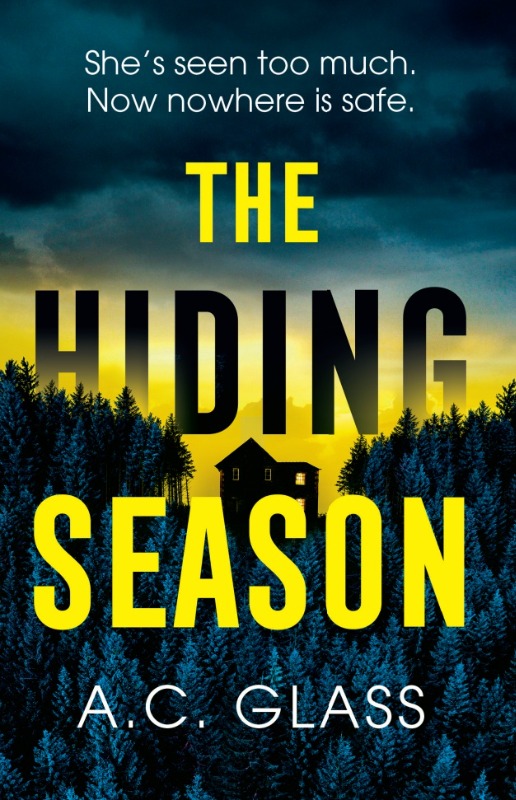
Her latest novel, The Hiding Season, takes as its central preoccupation the collateral damage that spies inflict upon ordinary people who wander, innocently, into their orbit. It is, Glass acknowledges, a subject she knows rather more about than she might have anticipated.
During her time working in counterterrorism, she was befriended by a young woman — "25, female, nothing like what you're told to look out for" — who seemed, for a few weeks, to be precisely the sort of companionable, curious friend you might hope to make in a new workplace. They talked a great deal. Glass, being an open book by nature, talked rather more than her new friend did. Then the friend disappeared.
"Someone told me a little later what had actually happened," she says, her tone shifting slightly. "And it was a gut punch. I just thought — was she laughing at me the whole time? Was I so obviously exactly what I said I was that she'd have figured it out straight away?" She pauses. "I felt like a fool. That's the hardest part, I think. You feel like you should have seen it coming." She shakes her head with a rueful smile. "You absolutely will not. When a spy comes for you, it will be nothing like what you expect."
She is sanguine about it now — eight years on, she says, the emotion has faded. But it is that specific feeling—the vertiginous realisation that someone you trusted was constructing an entirely fictional version of themselves for your benefit— that she has woven into the emotional architecture of The Hiding Season. The story is different, she is careful to say, but the feeling is the same.
And there is, she suggests, a strange kind of democracy to it. "Most people have probably met a spy at some point in their lives," she says, with the casual air of someone dropping a social hand grenade. "If you travel and pass through international airports—if someone stops to pick up something you dropped, speaks to you briefly, and asks you a couple of questions—odds are, you might have met one." She lets that settle for a moment. I spend a brief, slightly uncomfortable second reviewing my travel history.
Watching the Government Blow Things Up
Before the world of British intelligence, Glass spent years as an investigative journalist and crime reporter in America, covering murders and kidnappings alongside the FBI. Her description of that life is extraordinarily vivid: the police scanner running all night, the calculation of whether a call was serious enough to act on, the headlong race to reach a crime scene before the tape went up. "My job was to get there before the police sealed it," she says. "You have a window. You see what you can see, you speak to whoever you can speak to, and then they chuck you out. By then, hopefully, you will have your story."
On one occasion, however, her timing was somewhat misjudged. Responding to a call of an armed robbery on a quiet night—"I was only a few blocks away; I thought I'd see what was happening"—she arrived not after the incident, but during it. A man came charging out of a corner shop with a handgun in his hand and found her standing directly in front of him. "That", she says, with magnificent understatement, "was very poor planning." The police arrived a minute later. She became a witness. "You never want to be a witness as a reporter," she says, with the air of someone who has learned this lesson once and thoroughly.
.jpg)
Ava Glass
And yet the other part—the boots-on-the-ground human intelligence work, what the trade calls HUMINT, delivered with the relish of someone who has waited years to deploy that particular acronym—that part, she insists, is entirely real. "The people I worked with would disappear for two months," she says. "When they came back, they weren't allowed to tell me where they'd been. It killed me. I could just imagine what they had been doing." She still sounds a little put out about it.
She also participated, she says, in the kind of large-scale scenario planning that intelligence agencies conduct to prepare for catastrophic events—what she calls "spy gaming." This involved, among other things, watching the government blow up buildings in the countryside and studying the fallout. "If they blew up a chemical plant, where would the chemicals go? How quickly could they get people to safety?" It is, she says, happening all the time, which is why, when something terrible does occur, the response is so swift. "They've been practising."
The War Nobody Can See
For all its absurdities—the spy nod, the CIA agents inexplicably nursing pints in rural Wales, and the biometric-locked rooms full of people doing what looks very much like ordinary office work— Glass is clear-eyed about the stakes of the world she spent five years inhabiting.
"I came from journalism — what I would define as a normal life," she says. "And then, because of someone I met who offered me a job, I got to go into that world. The way I would describe it is this: for five years, somebody opened a door and showed me a war that is constantly going on. And then after five years, I walked out of that door, and I can't see that war anymore. But it's always there. Spies are always fighting to get information early enough to stop something terrible from happening. That's what they do, all day, every day. And it never ends."
It is, she argues, something the British public fundamentally underestimates: the sheer lethality of it. It's not about the glamour; it's about the death. "We think of spying as exciting, as a kind of adventure," she says. We often overlook the constant, absolute life-and-death nature of it. That is what I think most people miss."
Writing spy fiction in 2025 carries, she admits, a particular kind of urgency it did not always possess. Disinformation, state-sponsored interference, and the erosion of institutional trust—the subjects she has been fictionalising for years are now the daily texture of the news. She is currently halfway through a novel about Chinese espionage inside Parliament. The week we speak, a story breaks about precisely that subject. She says quietly, "Fiction and life are merging."
James Patterson has called her "the female heir to James Bond," though she gently bristles at the framing. Bond, she points out, is rather the mythology she is arguing against. In reality, nearly half of all spies are women. Women have run MI5. A woman runs MI6. "You do not get to the top of a spy agency for anything other than being absolutely brilliant at espionage," she says, with some firmness. "The women I met in that world were young, old, and completely ordinary—they looked like anyone. That's the point. The best spies blend into the walls. They are the ones people confide in. Because the best way to get information is simply to convince people to give it to you."
She says this with such easy authority that I realise I have spent the past hour doing exactly that: confiding in her, telling her things, finding her utterly credible and entirely trustworthy.
I wonder, briefly, if she has been checking me out.

Ava Glass
Monday 30 March 7pm Our Big Picture Grimsby
Tuesday 31st March, 7.30pm – The Pickering Booktree, North Yorkshire. Tickets: Free https://www.pickeringbooktree.co.uk/event/ava-glass/
Wednesday 1st April, 7pm – Wave of Nostalgia Howarth, West Yorkshire. Tickets £5. Event Link: https://waveofnostalgia.co.uk/products/an-evening-with-ava-glass-the-hiding-season-7pm-01apr26-wave-of-nostalgia-or-zoom
The Hiding Season (Penguin/Michael Joseph) is available now.
Also by Andrew Palmer...
Classical Music: Live From The Aspen Music Festival And SchoolClassical Music: Debussy: Piano Duets, Vol. 2Sheffield Teens Scoop Top Honours At BAFTA Young Game Designers AwardsIgor Levit Launches His Own Label With A Defiant Message For Troubled TimesClassical Music: Mel Bonis Orchestral Music