


search
date/time

Sun, 9:00PM
light rain
5.3°C
W 17mph
light rain
5.3°C
W 17mph
 | Sunrise | 6:26AM |
| Sunset | 6:13PM |  |

Andrew Palmer
Group Editor
P.ublished 14th March 2026
arts
Review
Classical Music: Laurence Osborn TOMB!
Dead forms, living music — Laurence Osborn at his most fearlessly inventive
TOMB! for strings, percussion & piano; Lakes, Mists, Bats, Daggers and Fountains for string quartet; Me and 4 Ponys for piano quintet; Coin Op Automata for string quartet & harpsichord.
12 Ensemble, GBSR Duo 1, Maha Esfahani harpsichord, George Barton percussion, Siwan Rhys piano, Clement Power conductor TOMB! & Coin Op Automata
Delphian DCD34350
https://www.delphianrecords.com/
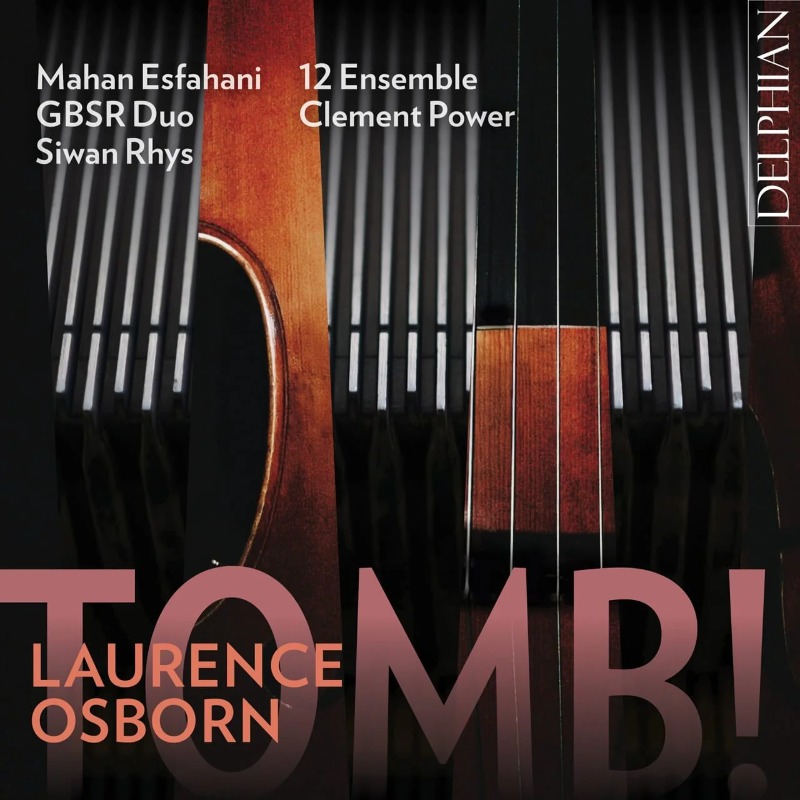
Laurence Osborn is a composer with a strong and distinctive voice—one that ranges from the arch and ironic to the deadly serious—and this collection of four pieces, engaging with classical music's heritage culture, the bold imaginative world of childhood, and the sometimes vertiginous boundary between the mechanical and the human, constitutes a powerful statement about where contemporary music can travel when it is in genuinely fearless hands.
The centrepiece — at least chronologically and conceptually — is TOMB!, a twenty-minute work for twelve solo strings, percussion and piano, winner of both an Ivor Novello Award and the RPS Award for Chamber-Scale Composition, performed here by the string soloists of 12 Ensemble alongside RPS Young Artist 2025 award winners GBSR Duo. Its animating concept is the tombeau, a genre originating in seventeenth-century French lute music, though most listeners will encounter it through Ravel's 1917 piano suite Le tombeau de Couperin, which already tilts toward meta-commentary in its own tradition. Where the Italian lamento wallowed in expressive grief, the tombeau offered something cooler and more oblique: a stylistic homage rather than a lament, commemorating a dead colleague by assuming their voice rather than mourning their absence.
Osborn takes this logic to its furthest reaches, treating dead musical objects and forms as decomposing material to be exhumed and reanimated. At the work's centre, he quotes a Monteverdi aria — a ghostly visitation that anchors the piece's necromantic programme with considerable dramatic force. As John Fallas observes in his illuminating booklet essay, the work falls into three broad sections, defined registrally and timbrally as well as symbolically by the contrasting notions of ascent and descent, and these structural divisions work with an almost theatrical clarity. The way the instruments converse and challenge one another is consistently absorbing, and the closing pages—where piano and tuned percussion combine to create a deliberate ambiguity—linger in the mind long after the final bar.
Lakes, Mists, Bats, Daggers, and Fountains take their unlikely inspiration from Bartók's fourth and fifth string quartets, and their opening pages—subdued and spectral, merging like lost, old music—are atmospheric in their deployment of dusky timbres and harmonic false relations, qualities Fallas characterises with particular acuity in his notes. Its curious title derives from a discovery Osborn made while reading David Cairns's biography of Berlioz: a satirical checklist published in the nineteenth-century Parisian journal Le Corsaire, which took gleeful aim at the Romantics with its inventory of greasy hair, incessant sighing and rapturous contemplation of precisely the objects named in his title. Designed to deflate, the images instead took on a life of their own in Osborn's imagination — vivid, strange, and genuinely fantastical. He is candid about his intentions, or rather his lack of them: these images caught his eye because they were irresistible, not because he had planned to illustrate them. There is something symbolically significant in that, a loosening of the conceptual grip and a readiness to let the musical imagination roam without a map.
Me and 4 Ponys, the earliest work on the disc, is a piano quintet that shows Osborn's range well, while the album closes with the superb Coin Op Automata, in which the virtuoso harpsichordist Mahan Esfahani takes centre stage. The work draws its inspiration partly from childhood — specifically, from a memory Osborn's wife shared with him of visits to a museum in Covent Garden filled with coin-operated machines: a mechanical family slurping spaghetti, a singing bird with a metal throat, and a miniature unicyclist lurching along a wire. These are machines that imitate human activity while remaining unmistakably machine-like, and Esfahani — himself one of the instrument's great advocates — inhabits the conceit with characteristic brilliance. The final movement is particularly arresting, its textural architecture building to a characteristically enigmatic close.
Throughout all four pieces, Osborn deploys virtuosic techniques with assurance, and his use of pizzicato is a recurring delight — nimble, pointed, and always purposeful. This is contemporary music that earns its difficulty, rewarding patience with moments of real illumination.