


search
date/time

Sat, 10:00PM
clear sky
21.4°C
SSW 9mph
clear sky
21.4°C
SSW 9mph
 | Sunrise | 3:38AM |
| Sunset | 8:49PM |  |

Steve Whitaker
Features Writer
@stevewhitaker1.bsky.social
P.ublished 27th June 2026
arts
Review: There's No 'F' In Wonderful By Bill Broady
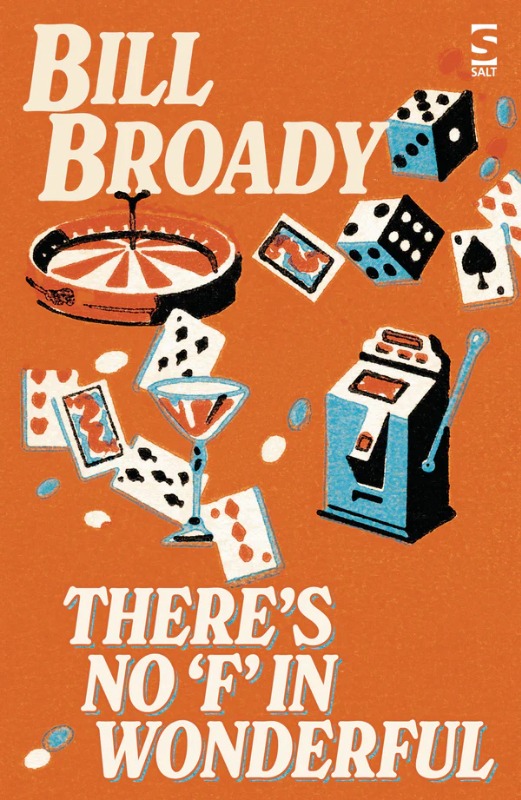
Such excess – the contemporary provincial landscape is captured through the lens of corrosive decline – is copious and withering: the narrator’s dive into the Malebolge rarely surfaces, as we explore the casinos, boozers, knocking shops and grim hotels of a fizzingly entertaining journey. If his narrative is katabatic, then Broady’s narrator is a kind of guide, a visitant who navigates a serpentine and aimless passage through the mire. Best served in moments of greatest abandonment to the blandishments of substance and alcohol, narrator and author sail perilously close to verisimilitude: beyond the vicissitudes of extensive research, Broady’s version of Leeds yields something closer to autobiographical authenticity.
Not least in those delicious sequences, trips if you like, that skew observation through a fug of dope or alcohol, or both. Broady is at his most persuasive when describing sex, or the pub/club scene, or even a trip to West Yorkshire’s cabaret hub, as if prismatically. Returning from an all-night piss-up in Batley and perceiving the universe through a cocktail of assorted drugs, the narrator and pals wait at the station for a creepily drawn early train, whose subsequent journey is hallucinatory:
‘We were not surprised to discover that no-one else was leaving Batley on the early morning train. This was, quite inexplicably, sixteen coaches long – re-commissioned dog-box carriages from between the wars. There was no driver in the cab…’
The amalgam of detail is a clever mechanism: disordering time and space, Broady adds architectural weight to the wider tableau, yielding a non-specific suggestion of discomfiture that pervades the narrative just below nose level. Leeds and its hinterland of the ‘Seventies look, sound and smell authentic: from the geography, to the seedy student digs, to the musical mapping and pubs of the period, Broady’s recalibration is not shy of using real street and district names to place the city in the threadbare and wheezy context of a half a century distant. If the Station Hotel is a facsimile of the ‘clean-sliced cliff’ of the Queens then the disguise is paper-thin.
Or of peopling the stage with figures whose raison d’etre is barely a raison d’etre at all, and entirely negotiated according to the demands of the literary intellect, and senses dulled by exposure to the uniform grey of cultural ennui: the story’s narrator – highly literate, self-effacing, immersed in substances and clinging to the wreckage; his best pal and flatmate Ed – odd, polymathic, lonely, steeped in the Classics and substance abuse; and Chris – wild, independently-spirited croupier whose synaesthesial obsessions, inability to use the letter ‘F’ in any form of discourse, and sado-masochistic proclivities render her both an object of fascination, and fundamentally unknowable. The three central protagonists all live interior lives; all are solipsists, except to the extent that they wittily intersect and are willing to exchange ideas through the prism, mostly, of humour.
Broady’s characterisation is every bit as convincing here as in his previous book – a brilliant examination of the early West Riding Labour movement as embodied in the actions of its leaders*: the novelist is spectacularly good at finding precisely the right dialogue to fit a disinterested descent into dissolution, and rendering it in a contextually nuanced argot. Finding corroboration, or a sense of antecedent fellow-feeling, in the comforts of art, the narrator and Ed’s exchanges are marked both by literary inference and intellectual re-appropriation:
‘”We are all lying in the gutter,” he enunciated carefully, “But some
of us are looking at the kerb.” On which perfect note he passed out.
I carried him out and laid him on the mattress where the
books rearranged themselves around his boneless form. He was the
only man I ever met who – heartbroken and off his face – was
capable of improving on Oscar Wilde.’
The scene is one example amongst a ubiquity, of the kind of wit and sardonic eloquence that distinguishes Broady’s writing from so many of his contemporaries: starkly counterpointed by the unsettling darkness of his subject-matter, Bill Broady’s effortless humour lifts narrative mood, even where he is occasionally guilty of over-egging the pudding. The novel’s central conceit – the narrator’s unlikely gift for sleight-of-hand draws him to work as a croupier in a Leeds casino – constitutes the larger part of the story: by any figurative definition occupying a space in one of Dante’s circles of Hell, the casino attracts the lost, the lonely, the embittered and the sociopathic to its sticky carpets and dimly-lit tables. Meticulously researched and painstakingly drawn, especially in the gaming sequences, the casino is a microcosm of the city’s malaise, a den of brutal misogyny towards which the staff are obliged to turn a blind eye, in these years immediately preceding the tenure of Peter Sutcliffe.
The narrator, who couldn’t declare a reason for being present if he knew the answer, is hyper-skilled but semi-detached; he operates the tables on auto-pilot, freeing-up mental space to observe both the denizens of the club and the much travelled Chris(tine), who later becomes an emotionally distant fuck-buddy and repository of shoes, with which she frequently confers. On the floor, the strange ‘Yehudi’, owing to his vague resemblance to the virtuoso violinist, who is at his most human, and cheerful, when losing, becomes the focus of the narrator’s obsession and reappears to the point of conspiracy as the story unfolds. The floor-walking, and in many ways most well-roundedly appalling, figure of Mr Gray, who dispenses misplaced wisdom and laboured aphorism at every turn, is a plausible caricature: at once jealous, venal and utterly devoid of insight, he fails, even, to recognise the joke delivered at his own expense.
It is fitting that narrator, Ed and Chris should part company at disparate angles to the narrative; an overwhelming denouement would be an unnecessary adjunct to an inverse bildungsroman of stasis and resettlement. The narrator’s final view of Ed, as he slopes off in his supremely anodyne ‘four-door cream Wolsey’, is one almost of disappointment:
‘It was apparent that his hair and clothes and the children, car
and marine conservation were merely attempts to make him seem
interesting now that he no longer was.’
Copies are available for pre-order here.
*The Night-Soil Men, published by Salt (2024)
Also by Steve Whitaker...
Poem Of The Week: Sleeping Through By Faith LawrencePoem Of The Week: Abra-Cadabra By Grace NicholsChildren’s Book Review: Hide And Seek: A Little Wizards Adventure By Sarah Jane ElliottThe Footsteps Of Dinosaurs: In Search Of Sea Dragons By Matthew MyerscoughPoem of the Week: When I Land in Northern Ireland By Colette Bryce