


search
date/time

Thu, 10:00PM
light rain
10.3°C
SSE 7mph
light rain
10.3°C
SSE 7mph
 | Sunrise | 5:07AM |
| Sunset | 7:14PM |  |
P.ublished 16th April 2026
frontpage
YouGov: Businesses Leaders Lack Confidence In The Economy, But Back Themselves To Succeed
YouGov’s first B2B Sentiment Tracker ran between 1 January – 31 March 2026 and captures the opinions and feelings of the nation’s enterprises at a moment of high external pressure. It finds that British businesses are confident in their own prospects, according to new quarterly YouGov data – but this optimism doesn’t extend to the wider economy.
How confident are British businesses in 2026?
Amid escalating conflict between the U.S. and Iran, and the corresponding impact on inflation, businesses register a score of 43.5 for our economic outlook metric. Any score below 50 is in negative territory. Confidence is higher among larger businesses with 250+ employees, with a score of 52.9, but markedly lower among SMEs (enterprises with under 250 employees), with a score of 37.4.
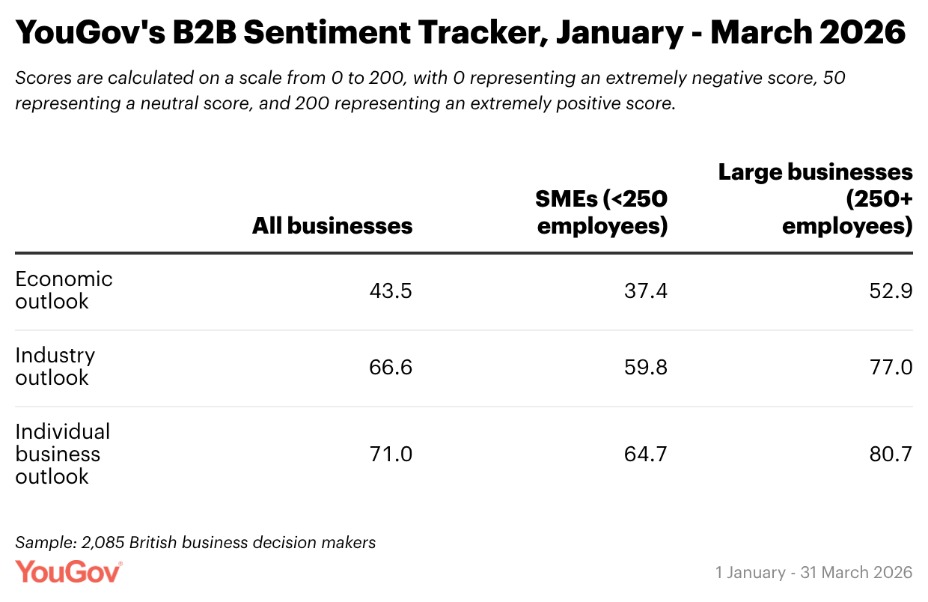
Digging deeper into specific industries, our data shows that IT and telco companies report the highest economic outlook scores (83.2), and the highest levels of positivity around their individual business outlook (105.9). This could reflect recent levels of AI-related investment in the sector, particularly in areas such as data centre spending. At the other end of the scale, legal firms are more cynical about both the economy (34.5), and their own fortunes (62.2), as are businesses in the hospitality and leisure sector (Economic outlook: 33.9; Individual outlook: 62.6).
Tracking pain points: British businesses are most concerned with costs and interest rates
We also asked enterprises about the most pressing concerns they are currently facing. More than half (56%) cite costs and interest rates, and nearly as many are worried.
.png)
Concerns vary significantly from the average depending on the industry. IT & telco companies, for example, are more worried about technological change (49% vs. 30% of all businesses), achieving growth (65% vs. 53%), geopolitical issues (54% vs. 42%), and accessing finance (31% vs. 19%) than the average. Legal companies are also disproportionately concerned about achieving growth (66% vs. 53%) and securing access to finance (25% vs. 19%).
For all the concern around growth, our data shows that UK businesses are more likely to expect a rise in revenue rather than a decline. Some 46% expect to see either slight (10%) increases in revenue during the next 12 months, with 25% expecting the opposite. The proportion expecting revenue gains rises to 56% among larger businesses and falling to 39% of SMEs.
Which factors will impact British business outlook over the next 12 months?
When YouGov asked businesses about the factors that would have the most influence over outlook in the next 12 months, the most-cited concerns – among those who did not have a neutral outlook are domestic demand for products and services (38%), and inflation and input costs (38%).
.png)