


search
date/time

Sat, 4:00AM
few clouds
7.0°C
WSW 6mph
few clouds
7.0°C
WSW 6mph
 | Sunrise | 5:36AM |
| Sunset | 6:51PM |  |

Andrew Palmer
Group Editor
P.ublished 4th April 2026
arts
Review
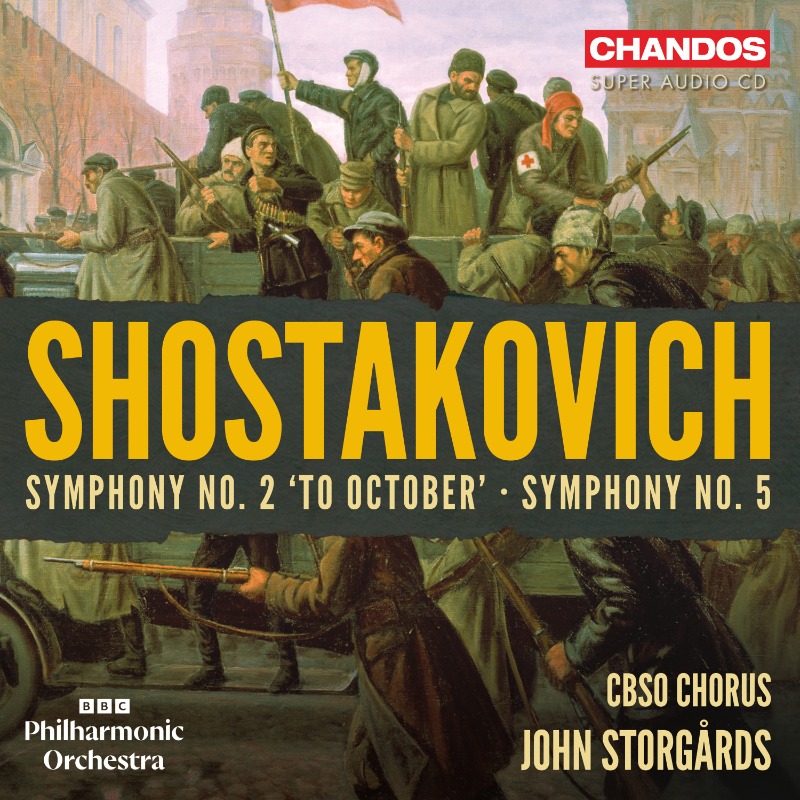
Classical Music: Shostakovich: Symphonies Nos 2 & 5
A Revolutionary Diptych from the BBC Philharmonic
BBC Philharmonic John Storgårds
CBSO Chorus Chandos
Chandos CHSA 5378
Chandos.net
This short, through-composed work of around twenty minutes unfolds across four sections: opening with a Largo intended to evoke the primordial chaos from which order would emerge and closing with a choral setting of Alexander Bezymensky's poem To October, its verses a paean to Lenin and the Revolution. A marked departure from the First Symphony's neoclassical poise, the work is far more modernist in idiom — a direction given fresh impetus by the Leningrad première of Berg's Wozzeck in June 1926, which fired Shostakovich's avant-garde instincts.
The miasmic opening is beautifully realised here. As the music begins to engulf the orchestra, Storgårds captures the full drama of that 'primordial chaos', building through a dark and complex web of orchestral texture, the atonality holding the listener rapt. The double basses provide an unerring foundation from which the woodwind and brass cut across with captivating clarity, Storgårds maintaining momentum with impressive control. The violin solo — delivered with electrifying precision and intensity by Yuri Torchinsky — is among the disc's many pleasures, as it segues effortlessly into the hand-wound claxon that conjures the factory hooter with period authenticity.
The CBSO Chorus rises magnificently to the choral finale, bringing fervent conviction to the entries, the drama of the differentiation between singing, speaking and shouting rendered with an authenticity that transports the listener to Russia itself. Between the ecstatic invocations of 'October', a brief recall of the miasmic opening and the return of the factory hooter compress the symphony's entire ideological trajectory into a few telling bars. David Fanning's notes are, as always in this series, exemplary.
The Second Symphony made little impression on its first hearings, in Russia or the West, and has remained a rarity in the concert hall. Its coupling could hardly offer a greater contrast. The Fifth Symphony received a standing ovation at its 1937 première, lasting more than half an hour, acclaimed both by Soviet officialdom — who judged it precisely the rehabilitation they had demanded — and by an audience that heard in it an expression of the suffering endured under Stalin. It has since become one of the most performed symphonies in the repertoire.
This is an outstanding disc in what is proving an increasingly distinguished cycle.
Also by Andrew Palmer...
Classical Music: Day Of These Days The British Isles Reflected In SongClassical Music: Tiento Classical Music: From Fire & Earthquake - Francisco GarroHidden Gem: Why York's Pearly Cow Is Worth Venturing Beyond The City WallsFull Service History: Matt Miller's Joyful Solo Show Gets Right Under The Bonnet